
- Garage-door
What to Do When Your Garage Door Will Not Open
Key Takeaways
|
A garage door that will not open can disrupt your routine, leave your vehicle inaccessible, and create a security concern for your home. While the issue may be as simple as a power interruption or depleted remote batteries, it can also point to mechanical failures such as broken springs, damaged cables, or malfunctioning safety sensors.
This guide explains how to troubleshoot a garage door that will not open, recognize common failure points, and determine when professional repair is the safest solution.
Start With These Safe Checks Before Assuming the Door Is Broken
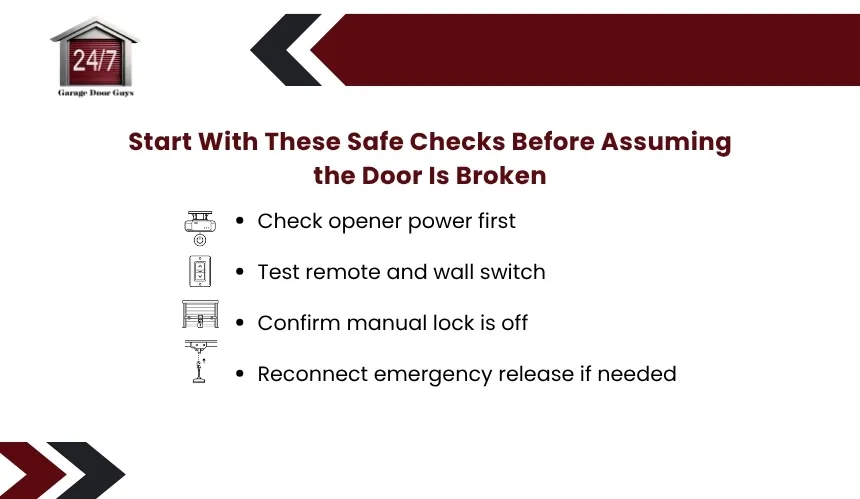
Before inspecting garage door components or scheduling a repair, rule out the most common issues that can prevent the door from opening. These initial checks require minimal tools, pose little safety risk, and often resolve problems caused by power interruptions, control issues, or accidental lock engagement.
Check the Power Supply and Garage Door Opener
A garage door opener depends on a consistent power source to operate. If the opener receives no electricity, neither the wall switch nor the remote control will activate the motor.
Start by confirming that the opener is plugged into a working outlet. If it is connected but unresponsive, check whether a tripped circuit breaker or GFCI outlet has interrupted power. If your neighborhood recently experienced a power outage, the opener may simply be waiting for electrical service to return.
When the opener has power but shows no indicator lights or produces no response, the unit itself may require further inspection rather than repeated operation attempts.
Test the Remote Control and Wall Switch
Comparing how different controls respond can help narrow down the source of the problem. If the wall-mounted control opens the garage door but the remote does not, the issue often involves depleted batteries, signal interference, or a remote that has lost its programming.
If neither the wall switch nor the remote activates the opener, the fault is more likely related to the opener, the electrical supply, or another system component. Testing both controls before moving on provides a clearer starting point for diagnosis and avoids replacing parts unnecessarily.
Make Sure the Manual Lock and Emergency Release Are Not Causing the Problem
Some garage doors include a manual slide lock that prevents the door from moving even when the opener is functioning correctly. Verify that this lock has not been engaged accidentally.
Also, inspect the emergency release cord. If it has been pulled, the garage door disconnects from the opener carriage, allowing manual operation during emergencies or power outages.
In this state, the opener motor may run, but it cannot lift the door until the trolley is properly reconnected. Confirming that these manual controls are in the correct position can eliminate a common source of confusion before investigating more complex mechanical problems.
Identify What Is Preventing the Garage Door From Opening
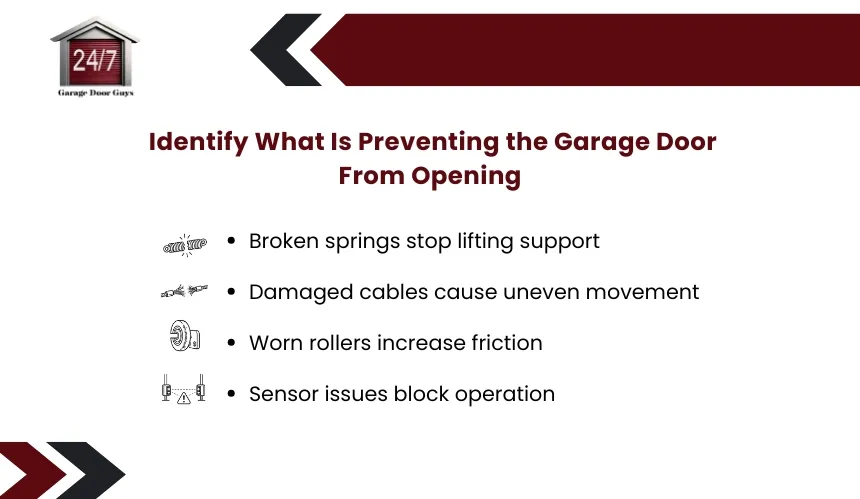
If the basic checks do not restore operation, the problem is likely within the garage door’s lifting system or safety mechanisms. Understanding which component has failed helps explain why the door will not open and whether the issue requires immediate professional attention.
Broken Garage Door Springs and Lifting Components
Garage door springs counterbalance the weight of the door, allowing it to open with minimal effort. When a torsion spring or extension spring breaks, the opener no longer has the support needed to lift the full weight of the door.
Common signs of a broken spring include a loud bang from the garage, a door that only lifts a few inches before stopping, or a door that feels unusually heavy when operated manually. Continuing to use the opener in this condition can overload the motor and accelerate wear on other components.
Damaged Cables, Rollers, or Tracks
The lifting system relies on cables, rollers, and tracks working together to guide the door smoothly. If a cable frays or snaps, the door can become uneven or jam in place. Likewise, bent tracks or worn rollers increase friction, preventing normal movement.
Visible gaps between the rollers and track, loose cables, or a door that appears crooked are strong indicators of a mechanical issue. These problems should not be forced by repeatedly pressing the opener, as doing so can worsen the damage or cause additional parts to fail.
Safety Sensor or Opener Problems
Modern garage doors include photo-eye safety sensors that stop the door from moving if they detect an obstruction. Dirt on the sensor lenses, misaligned sensors, or damaged wiring can interrupt the safety beam and prevent normal operation.
If the sensors appear clean and aligned but the opener still fails to respond, the issue may involve the opener’s internal components, such as the motor, drive gear, logic board, or capacitor. Unlike external adjustments, these electrical and mechanical faults typically require specialized testing to diagnose accurately and repair safely.
What You Can Safely Troubleshoot Yourself and What You Should Avoid
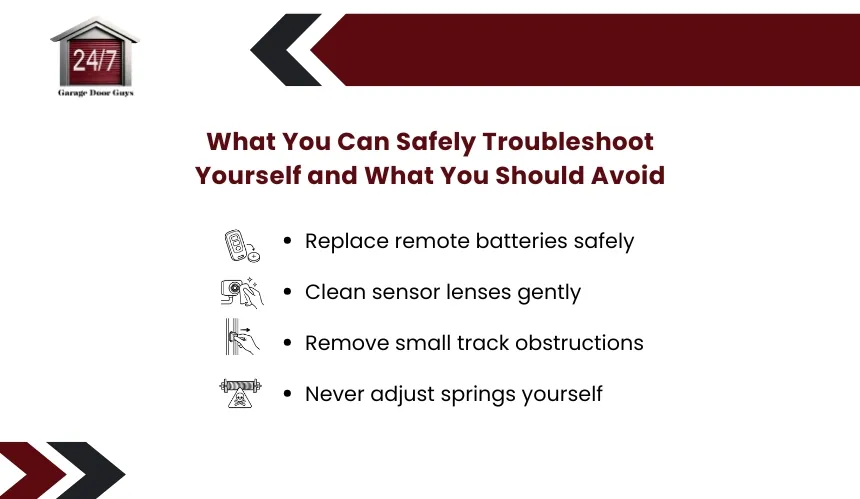
Not every garage door problem requires immediate repair, but not every repair is safe to attempt. Knowing where to stop protects both the garage door system and your personal safety while preventing minor issues from becoming more expensive repairs.
Safe DIY Troubleshooting Steps
Homeowners can safely perform a few non-invasive checks before requesting service. These actions do not involve disassembling high-tension components or altering the door’s operating system.
You can safely:
- Replace the batteries in the remote control if its range has decreased or it no longer responds.
- Remove dirt, cobwebs, or debris from the photo-eye safety sensors using a soft cloth.
- Inspect the tracks for small objects that may block the rollers from moving freely.
- Reset the garage door opener according to the manufacturer’s instructions if the unit has experienced a power interruption.
- Check for loose items stored near the door that could interfere with its movement.
If the door operates normally after one of these steps, continue monitoring it for consistent performance rather than assuming the issue has been permanently resolved.
Repairs You Should Never Attempt Yourself
Certain garage door repairs involve components under extreme mechanical tension or require specialized tools for safe adjustment. Attempting these repairs without proper training significantly increases the risk of injury and can damage the entire door system.
Avoid attempting to:
- Replace or adjust torsion or extension springs.
- Reattach or replace broken lifting cables.
- Modify opener force or travel limit settings without diagnosing the underlying cause.
- Straighten severely bent tracks or dismantle the lifting mechanism.
When the door remains stuck, appears uneven, or shows visible damage to critical components, professional repair is the safest course of action. Correcting the root cause protects the opener, preserves the door’s structural integrity, and reduces the likelihood of repeated breakdowns.
When It's Time to Call a Garage Door Repair Professional
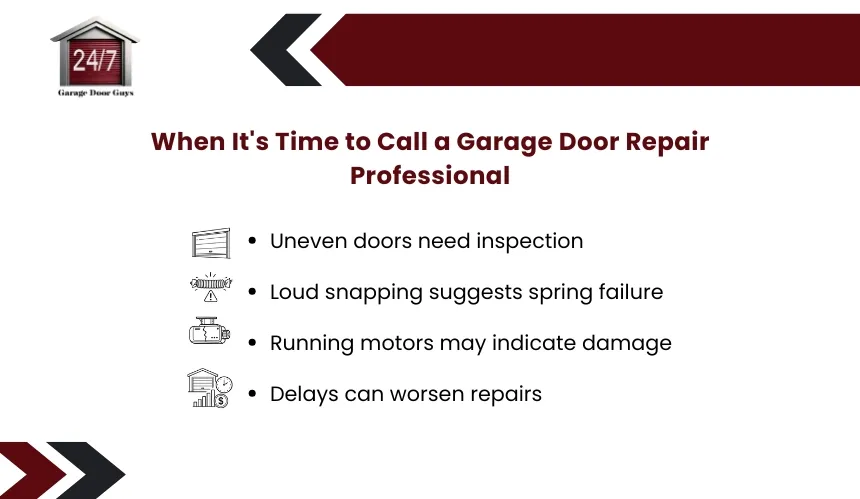
Some garage door issues can be identified through basic troubleshooting, but certain failures require immediate professional service. Recognizing these warning signs helps prevent further damage to the door system while reducing the risk of injury.
Warning Signs That Require Immediate Repair
A garage door should stop being used if it shows clear signs of mechanical failure. Continuing to operate the opener can place additional stress on already damaged components and increase repair complexity.
Contact a garage door repair professional if you notice:
- A loud snapping sound followed by the door refusing to open, which often indicates a broken spring.
- A door that hangs unevenly or appears crooked, suggesting a failed cable or lifting component.
- The opener motor runs, but the door barely moves or does not move at all.
- The door reverses unexpectedly without any visible obstruction.
- Broken springs, frayed cables, bent tracks, or damaged rollers that are visible during inspection.
These conditions affect both the safety and performance of the garage door system and should be addressed before the door is used again.
Why Delaying Repairs Can Make the Problem Worse
Garage door components operate as an interconnected system. When one part fails, the remaining components compensate by carrying additional load, which accelerates wear throughout the mechanism.
For example, a broken spring forces the opener to lift far more weight than it was designed to handle, increasing the likelihood of motor or drive system failure. Likewise, damaged rollers or misaligned tracks create excessive resistance that strains cables, hinges, and other moving parts.
Scheduling repairs soon after symptoms appear often limits the damage to a single component. Delaying service can allow a relatively straightforward repair to develop into a more extensive and costly replacement involving multiple parts.
If your garage door still will not open after basic troubleshooting, don’t risk further damage or personal injury. 247 Garage Door Guys provides fast, professional garage door repairs to diagnose the problem accurately and restore safe, reliable operation.
Frequently Asked Questions
Why won’t my garage door open when the temperature drops below freezing?
Cold weather can freeze the bottom weather seal to the concrete or increase resistance around moving parts. Clear packed snow, melt ice gently with warm water or a commercial de-icer, and dry the threshold before operating the door. Never force it upward, since that can tear the seal or strain the opener.
Why does the wall button work when none of my garage door remotes do?
The opener may be in Lock or Vacation mode, which disables handheld remotes while leaving the wired wall control active. Check the wall console for a flashing lock indicator and follow the model-specific instructions to deactivate it. This setting is often enabled accidentally while pressing nearby light or control buttons.
Can an LED bulb stop a garage door remote from working?
Certain LED and CFL bulbs emit radio-frequency interference that reduces remote range or blocks the signal entirely. Remove the recently installed bulb and test the remote again. If the operation returns, replace it with a garage-door-opener-compatible LED bulb designed to limit interference rather than repeatedly reprogramming the remote.
How can I enter the garage during a power outage if there is no side door?
A garage with no pedestrian entrance should have a keyed external emergency release or a battery-backup opener. The external kit allows the trolley to be disconnected from the outside during a power failure. Without either feature, avoid prying the door or attempting forced entry, which can damage panels, locks, and lifting hardware.
Will a smart garage door opener still work when the Wi-Fi is down?
A Wi-Fi outage usually affects app-based control, alerts, and remote monitoring rather than the opener’s basic motor function. Test the wired wall button or programmed handheld remote. If those controls work, restore the router connection or reconnect the opener to the network instead of treating the problem as a mechanical door failure.
Can a power surge damage a garage door opener without tripping the breaker?
A storm-related power surge can damage the opener’s circuit board even when electricity has returned, and the breaker remains on. Power-cycle the unit once, then check for erratic lights, clicking, lost remote programming, or intermittent movement. Continued malfunction requires professional electrical diagnosis rather than repeated resets or component swapping.