
- Garage-door
Is a Stuck Garage Door an Emergency?
Key Takeaways
|
A garage door that suddenly stops opening or closing can disrupt your day, but not every stuck door is a true emergency. The right response depends on whether the problem creates an immediate safety risk, leaves your home unsecured, or prevents essential access. This guide explains how to determine when a stuck garage door requires immediate professional repair and when it can safely wait for a scheduled service appointment.
When Is a Stuck Garage Door Considered an Emergency?
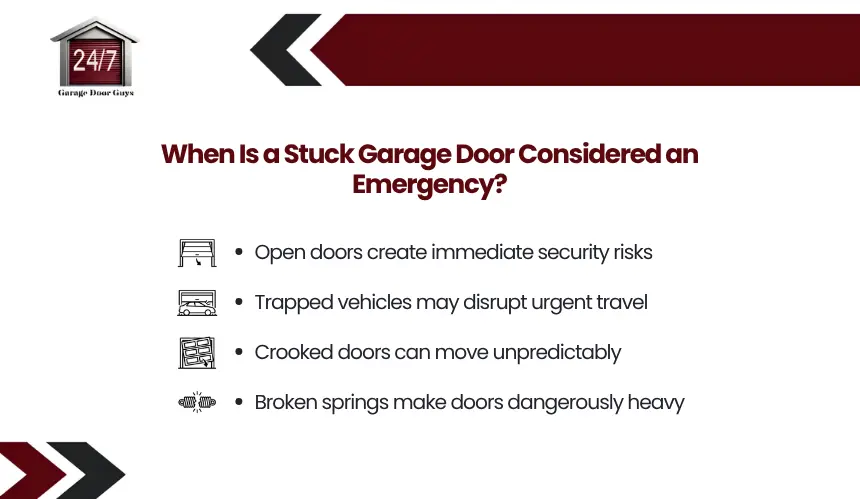
A stuck garage door becomes an emergency when it creates an immediate safety, security, or access issue. The urgency is determined by the risk the malfunction poses, not simply by the fact that the door has stopped moving. Identifying the severity of the problem helps you decide whether to request emergency garage door repair or schedule service during normal business hours.
What Situations Require Emergency Garage Door Repair?
Certain garage door failures should be addressed immediately because they can endanger people, damage property, or leave your home vulnerable.
- The door is stuck open: An open garage provides easy access to your home, vehicles, tools, and other valuables. If the door cannot be secured, emergency service is usually the safest option.
- Your vehicle is trapped during a time-sensitive situation: If you cannot access your vehicle for work, medical appointments, childcare, or another urgent obligation, waiting several days for repairs may not be practical.
- The door is hanging unevenly or appears unstable: A garage door that is crooked or partially suspended may indicate a failed lift cable or spring. Operating or standing beneath an unstable door increases the risk of sudden movement.
- A torsion spring or lift cable has broken: Garage door springs and cables support significant weight under high tension. When one fails, the door can become extremely heavy and unsafe to operate manually.
What Situations Can Usually Wait for a Scheduled Repair?
Not every garage door issue requires immediate attention. If the door remains secure and the malfunction does not create a safety hazard, scheduling a standard repair appointment is often appropriate.
- The door still opens and closes, but moves more slowly or noisily than normal.
- A remote control, keypad, or wall switch stops working while another control method still operates the door.
- Minor dents or cosmetic damage do not interfere with the door’s movement or structural integrity.
- Slight track alignment issues or worn rollers affect performance but do not prevent safe operation.
When the door remains functional, your home stays secure, and there is no immediate risk of injury or additional damage, a scheduled repair is generally the most practical and cost-effective choice.
What Can Cause a Garage Door to Get Stuck?
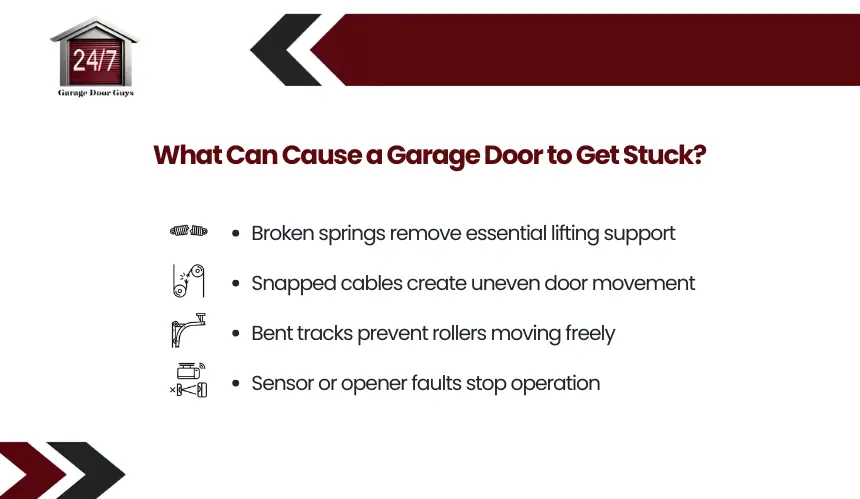
A garage door relies on multiple mechanical and electrical components working in balance. When one part fails or falls out of alignment, the entire system can stop moving or operate unpredictably. Identifying the underlying cause is essential because the appropriate repair depends on the specific component that has failed.
Broken or Worn Lifting Components
The lifting system carries most of the door’s weight every time it opens or closes. As these components wear, the door becomes harder to operate and may eventually stop moving altogether.
- Torsion or extension springs: Springs counterbalance the door’s weight. A broken spring removes that support, leaving the opener unable to lift the door and making manual operation extremely difficult.
- Lift cables: Cables work with the springs to raise and lower the door evenly. A frayed or snapped cable can cause one side of the door to drop, resulting in a crooked or jammed position.
- Rollers: Worn or damaged rollers create excessive friction as they travel through the tracks. This can interrupt smooth movement and eventually cause the door to bind.
- General component wear: Hinges, bearings, and other moving parts gradually deteriorate through repeated use, increasing resistance throughout the system.
Track, Sensor, and Opener Problems
Not every stuck garage door is caused by broken hardware. Electrical faults and alignment issues can also prevent normal operation.
- Bent or obstructed tracks: Even a slight bend can prevent rollers from moving freely, while debris lodged in the track can stop the door before it completes its travel.
- Misaligned safety sensors: Modern garage doors use photo-eye sensors to detect objects in the doorway. When the sensors lose alignment or become blocked, the opener may refuse to close the door as a safety precaution.
- Garage door opener failure: A worn drive gear, faulty logic board, damaged motor, or disconnected trolley can leave the opener running without moving the door.
- Power interruptions: Tripped breakers, unplugged openers, or electrical outages can make the system appear mechanically stuck when the issue is actually related to power.
Environmental and External Factors
Weather conditions and external influences can also affect garage door performance, particularly when routine maintenance is delayed.
In Bucks County, PA, winter temperatures, snow, and repeated freeze-thaw cycles can cause moisture to freeze along the bottom seal or around moving components. At the same time, seasonal temperature changes cause metal parts to expand and contract, gradually affecting spring tension, track alignment, and overall door movement.
Other external factors include accidental vehicle impacts that bend tracks, accumulated dirt that restricts roller movement, and insufficient lubrication that increases friction between moving parts. While these issues often develop gradually, they can eventually prevent the garage door from opening or closing until the underlying problem is professionally repaired.
What Should You Do Before Calling for Emergency Service?
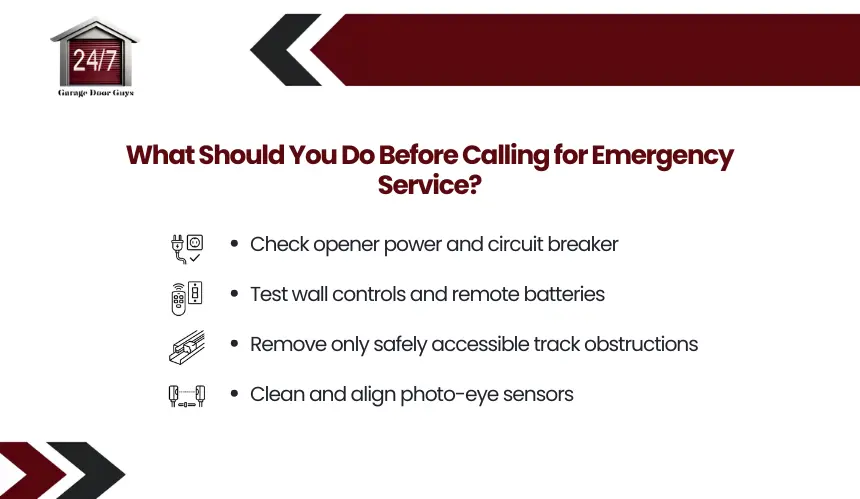
A garage door that stops working should be approached with caution. Before requesting emergency service, a few simple checks can help rule out minor issues without exposing you to unnecessary risk. If the problem involves high-tension components or an unstable door, professional repair is the safest course of action.
Safe Checks Homeowners Can Perform
Begin with basic inspections that do not require tools or contact with moving parts.
- Verify the power supply. Confirm that the garage door opener is plugged in and that the circuit breaker has not tripped. A power interruption can prevent the opener from responding even when the door itself is mechanically sound.
- Test different control methods. Try the wall-mounted control if the remote does not work, or replace the remote battery. If one control operates the door and another does not, the issue may be limited to the transmitter rather than the door system.
- Look for visible obstructions. Check the tracks for objects, built-up debris, or anything blocking the door’s travel. Remove only loose obstructions that can be cleared safely without forcing the door.
- Inspect the safety sensors. Ensure the photo-eye sensors are clean, facing one another, and free from anything interrupting the beam. Sensor misalignment commonly prevents the door from closing.
What You Should Never Attempt Yourself
Some garage door repairs involve components under extreme tension and should never be handled without the proper equipment and training.
- Do not adjust or replace garage door springs. Torsion and extension springs store significant energy and can cause severe injury if released unexpectedly.
- Do not disconnect or repair lift cables. A damaged cable may be supporting part of the door’s weight. Removing or loosening it can cause the door to shift or fall suddenly.
- Do not force the door open or closed. Applying excessive force can bend tracks, damage rollers, overload the opener, or worsen an existing mechanical failure.
- Do not continue operating a visibly damaged door. If the door is crooked, jerking during movement, or making loud snapping or grinding noises, stop using it immediately until it has been inspected.
If these basic checks do not restore normal operation, or if the door appears unstable at any point, avoid further troubleshooting and contact a qualified garage door technician. Continuing to operate a malfunctioning door can increase repair costs and create unnecessary safety hazards.
For many homeowners in Bucks County, PA, the garage serves as the primary entrance to the home, and daily commuting often depends on having immediate access to a vehicle. If a stuck garage door prevents essential travel or leaves the garage unsecured, requesting emergency repair is often the most practical decision.
How Professional Emergency Garage Door Repairs Restore Safety Quickly
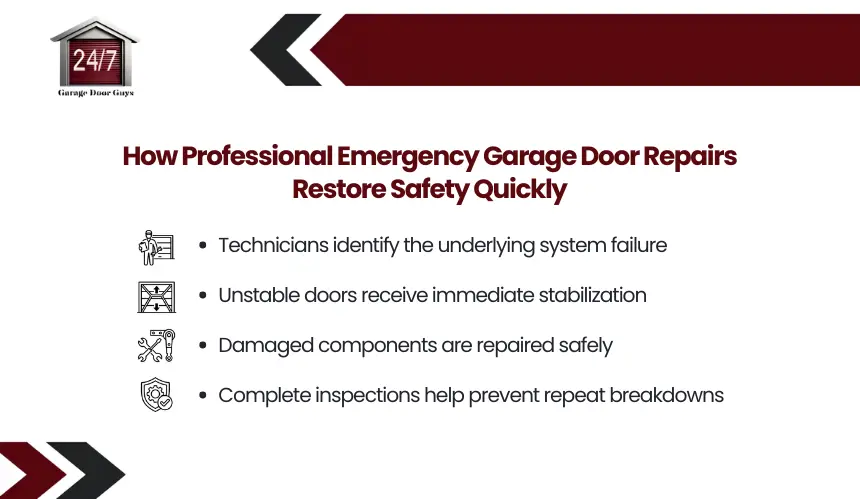
Professional emergency repairs are designed to address the underlying failure, stabilize the door, and restore safe operation without causing additional damage. Rather than replacing parts based on symptoms alone, experienced technicians inspect the entire garage door system to identify the component responsible for the malfunction and any related issues that could affect reliability.
What Technicians Inspect During an Emergency Visit
An emergency service call begins with a comprehensive inspection to determine why the door stopped operating and whether any components have become unsafe.
Technicians typically examine the spring system for signs of breakage or loss of tension, inspect lift cables for fraying or separation, and check the tracks for bends, loose mounting brackets, or obstructions that interfere with smooth travel. Rollers, hinges, and bearings are evaluated for excessive wear that could increase resistance or place uneven stress on the door.
The garage door opener is also tested to verify that the motor, drive mechanism, and control system are functioning correctly. Finally, the safety reversal system and photo-eye sensors are checked to ensure the door responds properly when an object is detected in its path. This complete evaluation helps prevent hidden mechanical issues from causing another unexpected breakdown shortly after the repair.
Preventing Future Garage Door Emergencies
The most effective way to reduce emergency repairs is to identify minor mechanical problems before they develop into complete system failures.
Routine maintenance allows worn rollers, loose hardware, aging springs, and misaligned tracks to be corrected while they are still relatively inexpensive to repair. Regular lubrication of moving components, periodic balance testing, and inspection of cables and safety devices also reduce unnecessary strain on the entire door system.
For homeowners in Bucks County, PA, seasonal weather changes can place additional stress on garage door components as temperatures fluctuate throughout the year. Scheduling preventive inspections before winter and addressing small performance changes early can significantly reduce the likelihood of needing emergency garage door repair in Bucks County, PA, when freezing conditions or increased daily use place the system under greater demand.
Professional repairs do more than restore movement. They ensure the garage door operates safely, protects your home, and reduces the risk of another unexpected failure when you depend on it most.
Don’t let a stuck garage door put your safety or security at risk. 247 Garage Door Guys provides fast, dependable emergency garage door repair services throughout Delaware and Southeastern Pennsylvania. Whether your door is stuck open, won’t move, or has a broken spring or cable, our experienced technicians are ready to restore safe, reliable operation.
Frequently Asked Questions
Can I pull the red emergency release when the garage door is stuck halfway?
Use the emergency release only when the door is fully closed and appears stable whenever possible. Pulling it while the door is raised or stuck halfway can disconnect the opener from an unbalanced door, allowing rapid movement. If the door feels unusually heavy or will not stay in place, stop and call a technician.
What happens if my detached garage has no other entrance during a power outage?
A detached garage with no service door can become inaccessible during an outage. An exterior keyed release allows the opener trolley to be disengaged from outside, while a battery-backup opener preserves powered access. Do not pry the top panel or fish for the release cord, because that can damage the door and weaken security.
Why does my garage door move manually but not with the opener?
When the door moves smoothly by hand but not through the opener, the problem is more likely within the operator system than the lifting hardware. Possible causes include a disengaged trolley, worn drive gear, failed logic board, incorrect travel limits, or a damaged belt or chain. A technician can isolate the failed component.
Why will my garage door not reconnect after using the manual release?
After manual operation, the trolley may remain disengaged even after power returns. Close the door, reset the release mechanism according to the opener’s manual, and operate the wall control so the trolley can reconnect. If it will not latch, avoid repeated cycles because the carriage, rail, or release assembly may be damaged.
Can a stuck garage door usually be repaired in one visit?
Many stuck doors can be restored during one visit when the panels, tracks, and supporting structure remain serviceable. Replacement becomes more practical when the door is severely bent, repeatedly leaves its tracks, has widespread panel damage, or requires several major components. The technician should compare repair cost, safety, remaining lifespan, and parts availability.
How can I secure a garage door that is stuck open until help arrives?
Secure the interior door between the garage and home, remove portable valuables, keep children and pets away, and avoid leaving the property unattended. Do not clamp tracks, disconnect cables, or force a crooked door downward. If the door can be closed safely without resistance, disconnect the opener afterward to prevent accidental activation.